Beyond the Boardroom: How Elite Founders Are Using Outdoor Settings to Drive Their Most Important Decisions

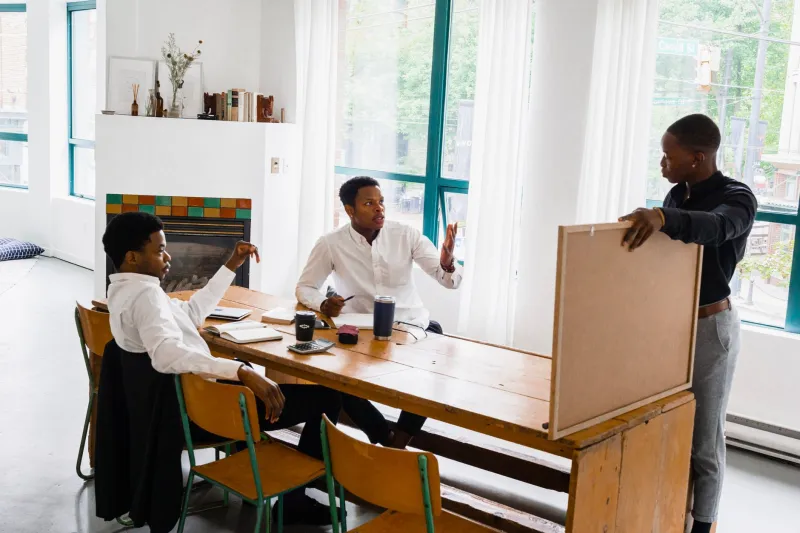
For decades, the corner office and the polished conference room have served as the defining symbols of executive authority. The mahogany table, the leather chairs, the whiteboard filled with quarterly projections—these were the instruments of serious business. Yet a quiet but meaningful shift is underway among some of the United States' most influential entrepreneurs and organizational leaders. Increasingly, the spaces where the most consequential decisions get made look less like corporate suites and more like a well-appointed backyard on a clear Tuesday morning.
This is not a casual trend. It is a deliberate recalibration of how leaders think about environment, cognition, and the conditions under which genuine strategic clarity emerges.
The Psychology of Open Space and Executive Thinking
Cognitive research has long suggested that physical environment shapes the quality of human thought. Studies conducted at institutions including Stanford University have demonstrated that walking outdoors measurably increases creative output compared to sitting in a stationary indoor setting. For entrepreneurs whose competitive advantage depends on novel thinking and rapid problem-solving, this finding carries significant practical weight.
Beyond creativity, outdoor environments appear to reduce the psychological defensiveness that often accompanies high-stakes business conversations held in formal settings. When two founders meet across a conference table, the architecture of that space implicitly signals hierarchy, evaluation, and performance. When those same two individuals sit in adjacent chairs on a garden patio, the dynamic shifts. The conversation becomes more exploratory, more honest, and—perhaps most critically—more productive.
Leadership coaches who work with C-suite executives across major American cities report that clients frequently describe their most transformative business conversations as having occurred outside traditional professional venues. The pattern is consistent enough that some coaches now actively prescribe outdoor settings for sessions involving difficult strategic pivots, partnership negotiations, or organizational restructuring.
Redesigning the Networking Ritual
For many entrepreneurs, the realization that outdoor spaces could serve as serious business environments came not from a management book but from lived experience. Sarah Okonkwo, who co-founded a supply chain technology firm based in Atlanta, describes the moment she stopped scheduling formal site visits for early-stage investor conversations.
"I had this moment where I realized that every time I brought a potential investor into our office, they were evaluating the office," she explains. "They were looking at our headcount, our square footage, our equipment. When I started inviting people to my home for a conversation in the backyard, the entire dynamic changed. They were evaluating the idea, and they were evaluating me as a person. That's where the real relationships started forming."
Okonkwo's experience reflects a broader pattern among founders who have intentionally restructured their networking approach around informal environments. Rather than relying solely on industry conferences, co-working space meetups, or formal pitch events, these leaders are cultivating what might be called intimate professional ecosystems—small, recurring gatherings held in residential or semi-private outdoor spaces where trust accumulates over time.
The logic is straightforward: authenticity scales poorly in formal settings, but thrives in environments that signal comfort, openness, and mutual respect.
The Strategic Value of the Informal Setting
It would be a mistake to characterize this movement as a rejection of professional rigor. The entrepreneurs who have most deliberately embraced outdoor decision-making environments are not abandoning structure—they are relocating it. The agenda still exists. The objectives are still defined. The due diligence still happens. What changes is the emotional register in which all of that work occurs.
Marcus Delaney, a serial entrepreneur and angel investor based in Austin, Texas, has hosted what he calls "yard sessions" for the past several years. These are informal two-hour gatherings held on his property, typically involving three to five founders at various stages of building their companies. No presentations, no pitch decks, no formal introductions. Just conversation, conducted outdoors, often without a fixed agenda.
"Some of the most valuable connections I've ever made for my portfolio companies happened at those sessions," Delaney says. "When you take away the performance pressure of a formal meeting, people tell you what they're actually working on, what's actually keeping them up at night. That's the information that matters. That's where you find the real opportunities to help each other."
Delaney is careful to note that the outdoor setting is not incidental to the quality of those conversations. "There's something about being outside—having sky above you, having some distance between you and the next person—that makes people more willing to think out loud. In an office, everyone's performing. Outside, people are just thinking."
Building a Culture of Candor
For organizations rather than individual entrepreneurs, the implications of this shift extend beyond personal networking into team culture and internal decision-making. A number of growth-stage companies across the US have begun incorporating outdoor settings into their leadership retreats, quarterly planning sessions, and even routine one-on-one meetings between managers and direct reports.
The rationale is partly psychological and partly symbolic. Leaders who deliberately choose to conduct difficult conversations in open, informal environments send a signal to their teams about the kind of dialogue they value. They are communicating, through the choice of setting itself, that candor is welcome, that hierarchy is not the point, and that the best ideas can come from anywhere.
This is particularly relevant in the current talent environment, where attracting and retaining skilled professionals often depends as much on organizational culture as on compensation. Leaders who demonstrate a genuine commitment to authentic communication—and who back that commitment with deliberate environmental choices—tend to build teams with higher trust, lower turnover, and stronger collaborative output.
What This Means for the Entrepreneur-Leader Community
The movement toward outdoor and informal decision-making environments is, at its core, a statement about what serious professional connection actually requires. It challenges the assumption that authority and credibility must be performed through formal architectural cues, and proposes instead that the most durable business relationships are built in spaces where people can simply be present with one another.
For the entrepreneurs and leaders who make up the iYard community, this represents both a practical opportunity and a philosophical invitation. The opportunity is concrete: consider whether your next critical conversation—a partnership discussion, a strategic planning session, a mentorship meeting—might benefit from a different kind of space. Step outside. Let the environment do some of the work.
The invitation is broader. In a business culture that often equates formality with seriousness, there is genuine competitive advantage available to those willing to question that equation. The leaders who are making their biggest decisions in backyards and on garden terraces are not being casual about their work. They are being deliberate about the conditions under which their best thinking emerges.
That distinction matters—and increasingly, it is the distinction that separates the most effective leaders from those still waiting for the perfect conference room to inspire them.